
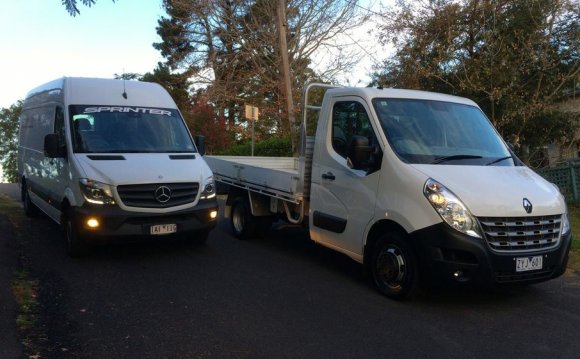
A push of a button switches the van from a two-wheel-drive hauler into a four-wheel-drive off-roader that just happens to carry a massive volume of stuff. On Sprinters so equipped, a second button press activates low range. In either 4x4 mode, 35 percent of torque is routed to the front axle while the other 65 percent powers the rear. Unlike Mercedes-Benz’s 4MATIC all-wheel drive, the torque split isn’t variable, so it’s best to leave the Sprinter in two-wheel-drive mode on dry pavement unless you enjoy the sounds of binding driveline components.
Up, Up, and Away—from Pavement
Unfortunately, the preproduction Sprinter 4x4s weren’t registered for street use, but a brief trip on pavement confirmed that, with four-wheel drive switched off, the 4x4s drive more or less identically to their two-wheel-drive counterparts. On Benz’s mini Rubicon, however, a short-wheelbase, high-roof Sprinter 4x4 with low range proved to be a different animal.
To help the long van clear obstacles (even the short 144-inch wheelbase is a recipe for high-centering), every 4x4’s suspension is raised 4.3 inches in front and 3.1 inches in back. The articulation limitations of the Sprinter’s independent front and solid-axle rear suspension are overcome by Mercedes-Benz’s Electronic Traction System (ETS). Essentially a few lines of code added to the van’s electronic stability control, ETS brakes traction-challenged wheel or wheels, which sends torque through that axle’s differential to the opposite wheel. Thus, even with one or two wheels hanging high above ground, the Sprinter 4x4 scampered over obstacles with the alacrity of a seriously bloated Jeep Wrangler. To cap off the dirt theater, we never once experienced anything approaching palpable chassis twist, an impressive feat for a vehicle with such a large, hollow, tubelike structure.
RELATED VIDEO



Share this Post
latest post
-
 Certified Pre Owned Mercedes Benz S550 August 5, 2015
 -
 Mercedes Benz dealership in Charlotte NC January 17, 2016
 -
 2012 Mercedes Benz Coupe April 24, 2014
 -
 Mercedes Benz 190e AMG July 10, 2017
 -
 2015 Mercedes-Benz S65 AMG August 5, 2016
 -
 2014 Mercedes Benz E63 AMG Wagon December 28, 2016
 -
 Mercedes Benz a Class fuel consumption October 19, 2012
 -
 Mercedes Benz used car dealership March 24, 2013
 -
 Mercedes-Benz Dealers Las Vegas August 23, 2015